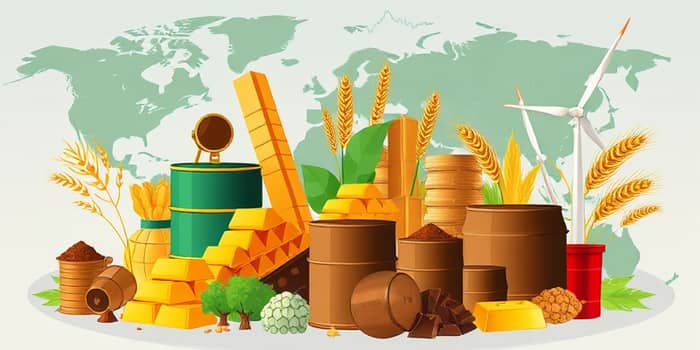
In a world defined by economic complexity and shifting geopolitical forces, raw materials remain fundamental building blocks of global growth. From energy and metals to agriculture, commodities offer investors both challenges and opportunities as they navigate 2025’s unpredictable markets.
With central banks grappling with persistent inflation and currency fluctuations, many are exploring physical and financial exposure to commodities as a means of preserving value and capturing long-term trends.
Commodities, also known as raw materials, encompass physical goods traded on global markets. These assets have intrinsic value rooted in real-world demand, making them distinct from equities or bonds.
Key categories include:
Each class behaves differently under macroeconomic pressures, offering unique risk-return profiles.
Incorporating raw materials into a diversified portfolio delivers several advantages. They serve as a robust defense against inflationary pressures, often rising in value when paper currencies weaken or when central banks loosen policy.
Moreover, commodities tend to have a low correlation with traditional financial assets, providing valuable portfolio diversification and risk mitigation during equity market downturns.
Commodity markets operate through spot exchanges, futures contracts, and over-the-counter transactions. Participants range from producers hedging output to speculators seeking profit from price swings.
Prices respond to a complex mix of supply-and-demand fundamentals, volatile global landscape shaped by geopolitics, and evolving policies on trade, environment, and energy.
Technological advances, such as digital trade finance and blockchain-based supply chain solutions, are also transforming how commodities are sourced, financed, and delivered.
The aggregate Commodity Price Index is projected to decline by 1% in 2025 following a modest 2% gain in 2024. Natural gas and precious metals have driven recent positive momentum, while crude oil remains under pressure from higher OPEC+ output and a resilient US dollar.
Central banks ramping up gold purchases amid persistent uncertainty has propelled prices to near-record levels. Meanwhile, critical minerals like lithium, nickel, and copper remain in demand for electric vehicles and renewable infrastructure, although new capacity may lag demand growth.
Each vehicle carries its own cost structure, tax implications, and risk characteristics. Investors should align their choice with personal objectives and risk tolerance.
Implementing rigorous risk controls—including position sizing, stop losses, and scenario analysis—helps manage these uncertainties effectively.
Despite headwinds, select themes offer attractive potential for patient investors:
Energy transition and electric vehicles continue to drive demand for a new generation of metals, providing growth opportunities for strategic allocations.
Commodities present a unique blend of risks and rewards. By offering tangible value preservation and exposure to fundamental economic drivers, raw materials can bolster returns and cushion portfolios against market turbulence.
To get started, allocate a small portion of capital to commodities and gradually adjust exposure as you gain experience. Mix direct and indirect instruments to balance complexity with diversification, and review your positions regularly to stay aligned with evolving macro trends.
With disciplined risk management and a focus on emerging themes, raw materials can become a powerful cornerstone of any forward-looking investment strategy in 2025 and beyond.
References